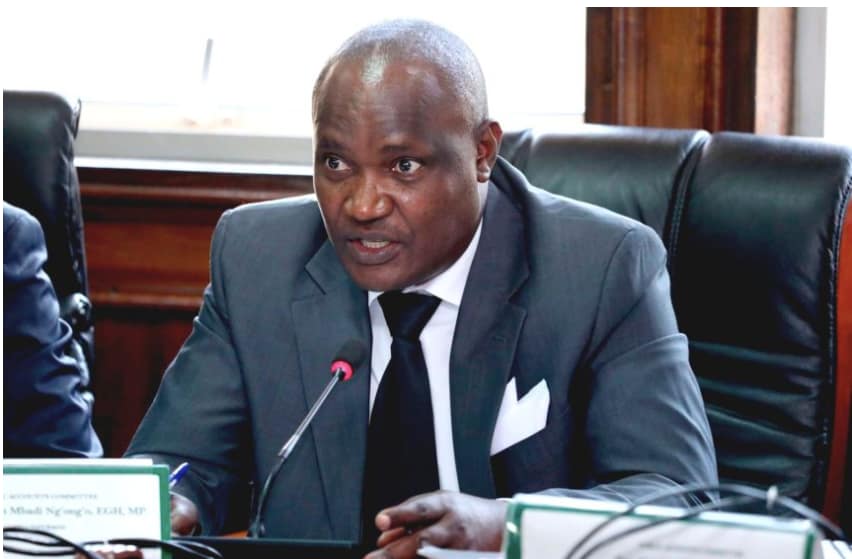

Treasury and Economic Planning Cabinet Secretary John Mbadi has defended the proposed Vision 2060, saying Kenya needs a new long-term development framework as Vision 2030 approaches its target year.
Mbadi said the proposed Vision 2060 should not be regarded as a personal initiative of President Ruto, but as a national undertaking that must be shaped through public participation in line with the 2010 Constitution.
“I’ve heard people say, ‘Why has Ruto developed another vision?’ Ruto has not developed a vision. Tomorrow, we are starting conversations on how to develop a vision for this country. That should come out clearly,” Mbadi stated.
The CS explained that the proposed new vision is necessary because Vision 2030, which was formulated in 2008 during the administration of former President Mwai Kibaki, is approaching its target year.
He said Vision 2030 has provided the foundation for Kenya’s development over the years, with government policies and political party manifestos largely aligned with its objectives.
“We have largely implemented Vision 2030. With a vision, you don’t have to hit all the targets. There are some misses. But largely, we have achieved a lot under Vision 2030,” Mbadi affirmed.
Mbadi noted that Kenya is currently implementing the fourth Medium-Term Plan under Vision 2030 and should therefore begin preparing the development framework that will guide the country beyond 2030.
“A country must start now conversing for the next vision. And that will be Vision 2060, as has been suggested,” he said.
Mbadi Calls for Public Participation
According to Mbadi, the development of Vision 2060 will provide an opportunity to assess the achievements and shortcomings of Vision 2030 while incorporating relevant lessons and successes into Kenya’s next long-term development strategy.
He contrasted the proposed process with the development of Vision 2030, which he described as largely a technical exercise conducted before the promulgation of the 2010 Constitution.
“With the 2010 Constitution, public participation is mandatory,” he stressed.
Mbadi said consultations on Vision 2060 would give Kenyans, including opposition leaders, an opportunity to present alternative ideas and proposals on the country’s future.
“If you have better ideas, this is the time for you to come. In fact, the President has invited even the opposition. Come, tomorrow we start engagement,” he urged.
He dismissed suggestions that Vision 2060 would belong solely to President Ruto, noting that the proposed development framework would extend across several administrations.
“Vision 2060 is not for William Ruto. Ruto can only be in power up to 2032, not beyond. Therefore, this vision is not his. In fact, he will implement a very small part of that vision,” Mbadi clarified.
Team Appointed to Guide Vision 2060 Consultations
Mbadi announced that the Ministry of Economic Planning has established a team led by Professor Nyong’o and international economic consultant Professor Hiroyuki Hino to develop a framework for the national consultations.
The team has already submitted a report outlining how the country should approach the process.
“Now is the time to sit together, engage, dialogue, agree on where Kenya is going,” Mbadi said.
The proposed Vision 2060 is expected to provide a long-term development framework spanning successive administrations. Mbadi said the process should focus on Kenya’s aspirations for the coming decades rather than the political interests of any single administration.
He noted that President Ruto has expressed an ambition for Kenya to attain first-world status within the next 20-25 years, arguing that the country has already established some of the foundations needed to pursue that goal.
“It is achievable. It is possible. We have already laid the foundation, the building blocks, which were started during President Kibaki’s time. President Ruto as actually built very strongly on those building blocks,” Mbadi said.
The Treasury CS also defended the government’s performance, saying Kenyans would ultimately judge the Ruto administration based on its record and achievements.
He said the proposed national conversation and Vision 2060 consultations should provide a broader platform for discussing Kenya’s development priorities instead of becoming another political contest.
Mbadi said the dialogue would allow citizens, political leaders, experts and other stakeholders to contribute ideas that could shape Kenya’s next long-term development strategy.