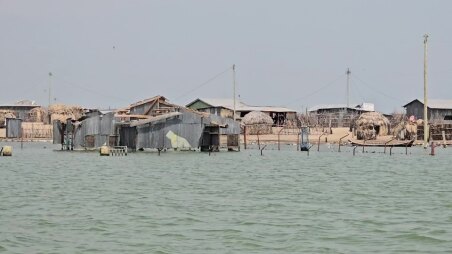
Communities living along the shores of Lake Turkana are facing an escalating crisis as rising water levels continue to swallow homes, schools, roads, businesses, grazing areas and ancestral burial grounds, forcing families to abandon settlements they have occupied for generations.
In affected areas such as Kalokol and Long’ech, the expanding shoreline is disrupting education, fishing activities, transport and access to essential services, while threatening the cultural heritage of communities whose lives have long depended on the lake.
The rising waters are also putting pressure on household incomes. Fishermen are struggling with changing fishing conditions and declining catches, while fish traders face reduced supplies and higher transportation costs.
Some residents have been forced to explore alternative sources of income, including boat transport, motorcycle services and selling water, as traditional livelihoods become increasingly difficult to sustain.
ALSO READ
Climate Change and Human Activities Driving the Expansion
Scientists attribute the rise in Lake Turkana's water levels to several interacting environmental factors, including prolonged rainfall in the lake's catchment areas, increased river inflows, climate variability and changes in land use.
The Omo River in Ethiopia is particularly important because it contributes more than 90 per cent of the lake's inflow.
James Last, a senior research scientist at the Kenya Marine and Fisheries Research Institute (KMFRI), identifies heavy and prolonged rainfall in the river catchment areas, particularly the Omo basin, as a major driver of the rising water levels.
He says human activities have further intensified the effects of changing weather patterns.
“Long-term shifts in temperature and weather patterns, combined with human activities, are driving climate change here in Turkana,” Last explains.
He also points to deforestation, charcoal production, wood harvesting, agricultural expansion and construction as activities contributing to environmental degradation.
“Deforestation for charcoal and wood fuel, land clearing for farming, and construction have significantly worsened the situation,” he adds.
According to Last, clearing vegetation and cultivating steep slopes reduce the ground's ability to absorb rainfall. This increases surface runoff and soil erosion, allowing more water and sediment to enter rivers feeding the lake.
The resulting changes in the catchment areas can also increase sediment movement and siltation, adding pressure to an already vulnerable ecosystem.
Strong Winds Intensify Shoreline Flooding
Wind activity across Lake Turkana is another factor worsening conditions along the shoreline.
Because the lake has a vast, relatively open surface, strong winds can travel across long distances and generate waves that push water towards settlements and infrastructure.
Last says wind speeds frequently exceed 8–10 metres per second, creating large waves capable of carrying water further inland.
“The stronger the wind and the longer it blows, the larger the waves become,” he says, explaining that the strength and duration of winds influence how far water can reach inland.
These waves can worsen flooding in low-lying settlements, damage structures and make fishing and boat transport more dangerous.
Homes, Schools and Cultural Heritage at Risk
The expansion of the lake has submerged or threatened important community infrastructure, including homes, roads, schools, sanitation facilities, fishing infrastructure and other public amenities.
For families living along the shoreline, displacement means more than losing shelter. It can also mean separation from ancestral land, burial grounds, community institutions and traditional sources of income.
The disruption to schools has created additional challenges for children whose families have been forced to move or whose learning facilities have been affected by flooding.
There are also concerns about sanitation and waterborne diseases in areas where rising water levels have submerged facilities and altered living conditions.
Scientists warn that continued expansion could expose more households to displacement and increase pressure on already limited services.
Fishing Communities Search for Alternative Livelihoods
Fishing remains one of the main economic activities supporting communities around Lake Turkana. However, changing shoreline conditions, submerged landing sites and increasingly difficult fishing operations are putting pressure on the sector.
Fishermen face hazardous conditions on the water, while traders struggle with inconsistent fish supplies and the additional costs of transporting their products.
Some residents are turning to other activities, including transporting passengers and goods by boat, motorcycle services and water vending, in an effort to maintain their household incomes.
The disruption threatens not only individual families but also the wider fishing economy, which supports traders, transport operators and other businesses.
Calls for Research and Long-Term Solutions
The worsening situation has renewed calls for coordinated scientific research, stronger disaster preparedness and sustainable environmental management around the lake basin.
Experts say authorities need reliable information on changing water levels, rainfall patterns, river inflows and shoreline conditions to guide planning and protect vulnerable settlements.
There is also a need for safer relocation arrangements for families living in high-risk areas, alongside measures to protect livelihoods, education, sanitation and essential public services.
Possible geological changes beneath the lake basin have also been raised as an area requiring further scientific investigation, although their contribution to the rising water levels should not be treated as established without stronger evidence.
As Lake Turkana continues to reshape the surrounding landscape, affected communities face an uncertain future. Protecting their homes, livelihoods and cultural heritage will require sustained cooperation between national and county governments, researchers and local residents.