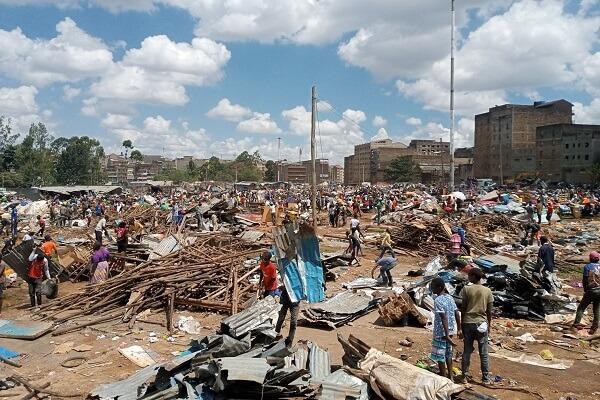
WATAMU, Kilifi County — More than 38 families in the Jacaranda area of Watamu have been left homeless following demolitions linked to a land ownership dispute, with affected residents accusing authorities of failing to protect them.
The residents said the demolitions began at around 4am, when a group accompanied by police officers, hired individuals and a grader allegedly entered the area and pulled down homes without prior notice.
Several affected families said they had invested their savings in permanent houses, including multi-storey residential buildings, before the structures were demolished.
The demolitions reportedly took place during heavy rainfall, leaving residents scrambling to salvage their belongings as their homes were brought down.
Residents Say Demolitions Have Happened Before
Hamisi Kombe, popularly known as Robby Rasta, said it was the third time demolitions had been carried out in the area under police supervision.
He criticised local leaders for what he described as a lack of support, saying residents had spent decades seeking official documents to establish ownership of the land.
“We have struggled for decades trying to push authorities to give us land ownership documents in vain, to date we are still called squatters, those who call themselves leaders have not come here and we do not understand them,” he said.
Kombe appealed to President William Ruto to intervene following his recent tour of the Coast region, during which thousands of title deeds were distributed.
The residents want the government to help resolve the ownership dispute and provide clarity on their claims to the land.
Families Count Losses After Homes Are Demolished
Moki Katana, one of those affected, said he had lived in Jacaranda for more than 30 years and spent years building what he described as his dream home.
He alleged that masked police officers and more than 80 hired individuals arrived in two lorries before the demolitions began.
Katana appealed to the government to intervene, saying affected families had nowhere to go and that some children were sleeping in the cold and unable to attend school.
“For us we just want justice. The National Government please come and help us because we are suffering,” he said.
Beatrice Dume said her daughter called her early in the morning to report that her house was being demolished.
She said she rushed to the scene but was prevented by police from accessing her daughter.
“We want justice. I want my daughter to be compensated for the losses she incurred from the demolition,” Dume said.
Residents Demand Compensation for Lost Property
Another affected resident, Jackson Tsuwi, said the demolitions destroyed their homes and that household items had allegedly been stolen during the operation.
“We ask the government to help us because we have nothing at all here and we do not know where to go, we want to be compensated,” he said.
Tsuwi alleged that a businessman claiming ownership of approximately 300 acres of land had taken the matter to court but proceeded with the demolitions before the dispute had been concluded.
The allegation raises questions about the legal status of the contested land and whether the demolitions were carried out under a valid court order.
The supplied account does not include court documents, a response from the alleged landowner or an official statement from the police.
Calls for Government Intervention
The affected residents are calling on the national and county governments to intervene, help establish ownership of the disputed land and ensure that their grievances are addressed.
They also want compensation for destroyed property and assistance for families left without shelter.
The dispute has renewed concerns among residents about access to land ownership documents and the protection of households whose claims to occupied land remain unresolved.
As affected families seek assistance, clarification of the property's legal ownership and the circumstances surrounding the demolitions will be central to determining the next steps.
The residents say they want a lasting resolution that addresses their claims, protects their families and prevents further displacement.