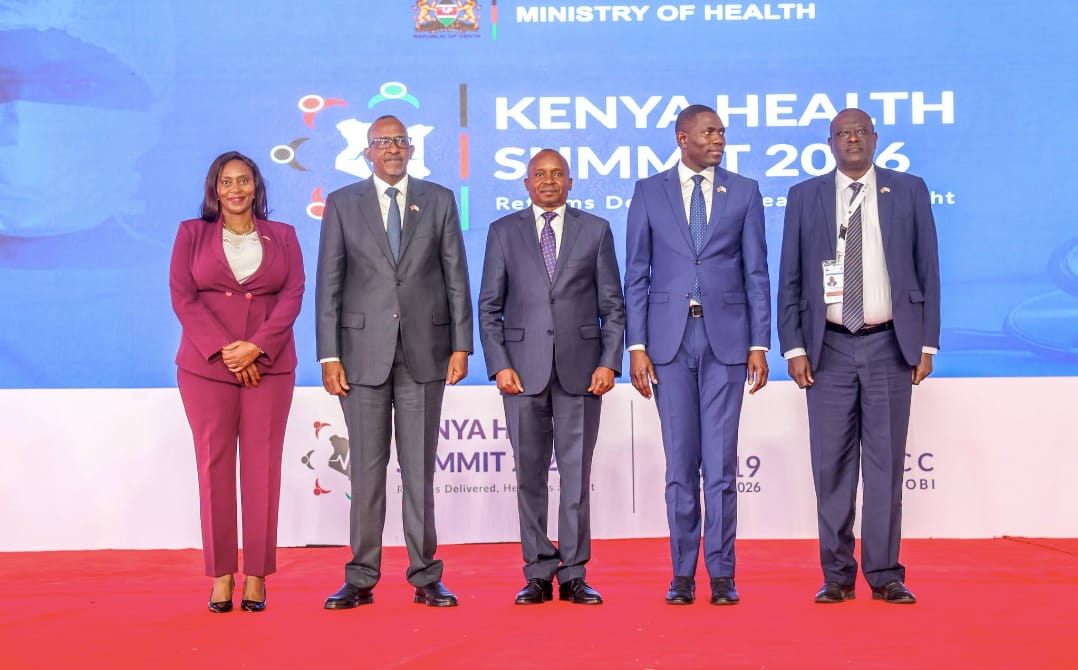

Deputy President Kithure Kindiki has said the government is intensifying efforts to register more Kenyans under the Social Health Authority (SHA), with a target of reaching 40 million members by the end of 2026.
Kindiki said the registration drive is central to the government’s Taifa Care programme, which he described as Kenya’s most significant healthcare initiative since independence.
Speaking during the second day of the Kenya Health Summit at the Kenyatta International Convention Centre (KICC) in Nairobi, Kindiki said about 32 million Kenyans had already been registered under SHA over the past two years.
“It appeared impossible four years ago but now healthcare universality is a possibility. We can smell it. We hope by the end of the year we will reach 40 million people and by next August we will have all Kenyans registered,” the DP said.
President Ruto opened the two-day Kenya Health Summit on Tuesday, engaging health sector stakeholders and beneficiaries on the progress and challenges facing Kenya’s healthcare system.
SHA Coverage at 60%
Kindiki said the government’s broader objective is to achieve universal health coverage by ensuring Kenyans can access quality medical services regardless of their location or economic status.
“The Universal Health Coverage is about the health of the people of Kenya. Better quality healthcare for every citizen. We are now around 60% coverage. This is not a small measure compared to other countries,” he stated.
The DP said progress in SHA registration was being supported by increased investment in the health workforce, equipment and primary healthcare services.
Since 2022, he said, the government has deployed 24,573 healthcare interns across all 47 counties, sponsored 262 medical registrars for specialist training and committed to recruiting an additional 5,000 nurses and midwives.
The government has also worked with county administrations to recruit 107,000 Community Health Promoters (CHPs), who serve as the first point of contact between households and the healthcare system.
Kindiki said CHP kits were being replenished, while the government was considering improved monthly stipends for the health workers.
“Our objective is straightforward: a health system that works for the first time, works in every county and works for every Kenyan,” Kindiki said.
Expand Medical Equipment
The DP said the government had also expanded access to specialized healthcare through investment in medical equipment.
Under the National Equipment Service Programme (NESP), he said medical equipment worth KSh9.8 billion had been delivered to 239 health facilities across 44 counties.
The equipment, he added, had contributed to improved diagnosis and treatment of diseases.
Kindiki further said more than 500,000 surgical procedures and over 50,000 cancer care services had been supported through the Social Health Insurance Fund (SHIF) and the Emergency Chronic and Critical Illness Fund (ECCIF).
Improve Medicine Supply
Kindiki said the government was also strengthening the supply of medicines and other essential medical commodities through the Kenya Medical Supplies Agency (KEMSA), which has undergone restructuring since 2022.
He stressed that improving the availability of medicines must go hand in hand with ensuring their safety and quality.
“Availability of medicine must also mean safety and quality. The Pharmacy and Poisons Board must strengthen efficient regulation, post-market surveillance and pharmacovigilance, and act firmly against falsified and substandard products,’ he said.
KSh27.4 Billion for Primary Healthcare
The DP said the Primary Healthcare Fund, a key component of the government’s universal health coverage strategy, had received KSh27.4 billion and disbursed KSh23.3 billion to more than 9,300 Level 2 and Level 3 health facilities.
The funding has supported more than 20 million outpatient visits involving over 15 million Kenyans, according to Kindiki.
He added that Primary Care Networks had expanded from two pilot sets in 2022 to 278 hubs across the country.
Kindiki said the government’s focus was now to translate healthcare reforms and investments into reliable services for Kenyans across all counties.