
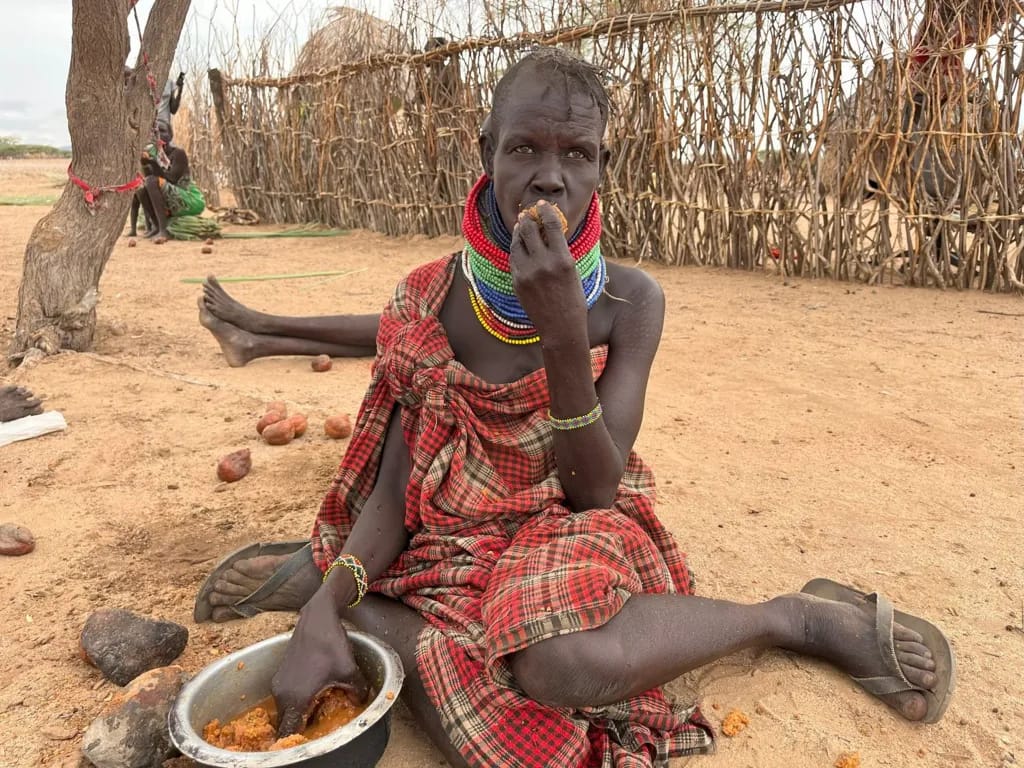

In the arid plains of Turkana County, Lotukoi Ebei surveys what remains of her livelihood- five weak goats, all that is left of a herd that once numbered 50.
One by one, the animals died as drought tightened its grip across north-western Kenya, wiping out pasture and water sources that pastoralist communities depend on. In Turkana, livestock are more than income; they’re the backbone of survival. Their loss marks the unravelling of entire households.
“I sometimes go for days without food,” Ebei says in a faint voice, describing a reality where even a single meal a day is no longer guaranteed.
Her story is echoed across the region, where the effects of prolonged drought continue to devastate communities despite the recent onset of rains in parts of Kenya. Officials warn the rainfall has been sporadic and insufficient in Turkana, offering little immediate relief after two failed rainy seasons.
According to the National Drought Management Authority, the uneven distribution of rainfall means that large swathes of the county remain dry, with grazing land yet to recover.
The crisis stretches beyond Kenya’s borders. Across East Africa, an estimated 26 million people are facing extreme hunger, according to Oxfam.
RELATED NEWS:
- “We Fight for Water”: Life Inside Turkana’s Drought
- Lomodo Raises Concerns Over Disarmament Operation In Pokot and Turkana
- Turkana Assembly Suspends Ksh 15,000 Bursary Plan
In Turkana, the impact is stark. Riverbeds have run dry, vegetation has withered, and the few surviving animals are too weak to sustain families. For many households, hunger has become a constant companion.
In Kakwanyang village, women gather beneath a tree, pounding wild fruits locally known as “eengol,” harvested from doum palm trees. Once considered a snack, the fruit has now become a critical food source.
“We eat these because of hunger,” says Regina Lokopu, who has lost nearly her entire herd and now shares what little she finds with her last remaining goat.
The fruits are not without risk. Consumed in excess, they can cause stomach complications, but for many families, there are no alternatives. On rare occasions, they mix the fruit with maize flour- if they can afford it- to make it safer to eat.
Elsewhere, in Lotiman village, residents describe similar hardship. Kerio Ilikwel says she has gone three days without food, relying on neighbours for occasional help. But even that support is dwindling as the crisis deepens.
“Help us,” pleads Akale Helen, her voice urgent as she describes the worsening hunger. “We don’t have food, and even the goats have nothing to eat.”
Many men have migrated with the few animals left, crossing into neighbouring regions in search of pasture, leaving women and children behind to cope with the scarcity.
Local authorities say the situation is dire. More than 320,000 people in Turkana are in urgent need of food assistance, with around three million affected nationwide.
Relief efforts are ongoing but limited. At a food depot near Lodwar, the Kenya Red Cross Society is distributing supplies to vulnerable households, while agencies such as World Vision Kenya and the World Food Programme continue to support affected communities.
However, aid workers acknowledge that resources fall far short of the need.
“We have only a small amount of food, which cannot reach everyone,” a local Red Cross official says, appealing for additional support from partners and donors.
The Kenyan government has pledged to scale up food distribution and provide livestock feed in drought-affected counties, but officials caution that recovery will take time.
For families like Ebei’s, the immediate concern is survival. With livestock gone and food scarce, they are left to depend on what little remains- and on the hope that help will arrive before conditions worsen further.