
In the relentless heat of Kainama in Turkana County, Veronica Akalapatan and her neighbours walk several kilometres each day in search water, navigating a landscape defined by dust and drought.
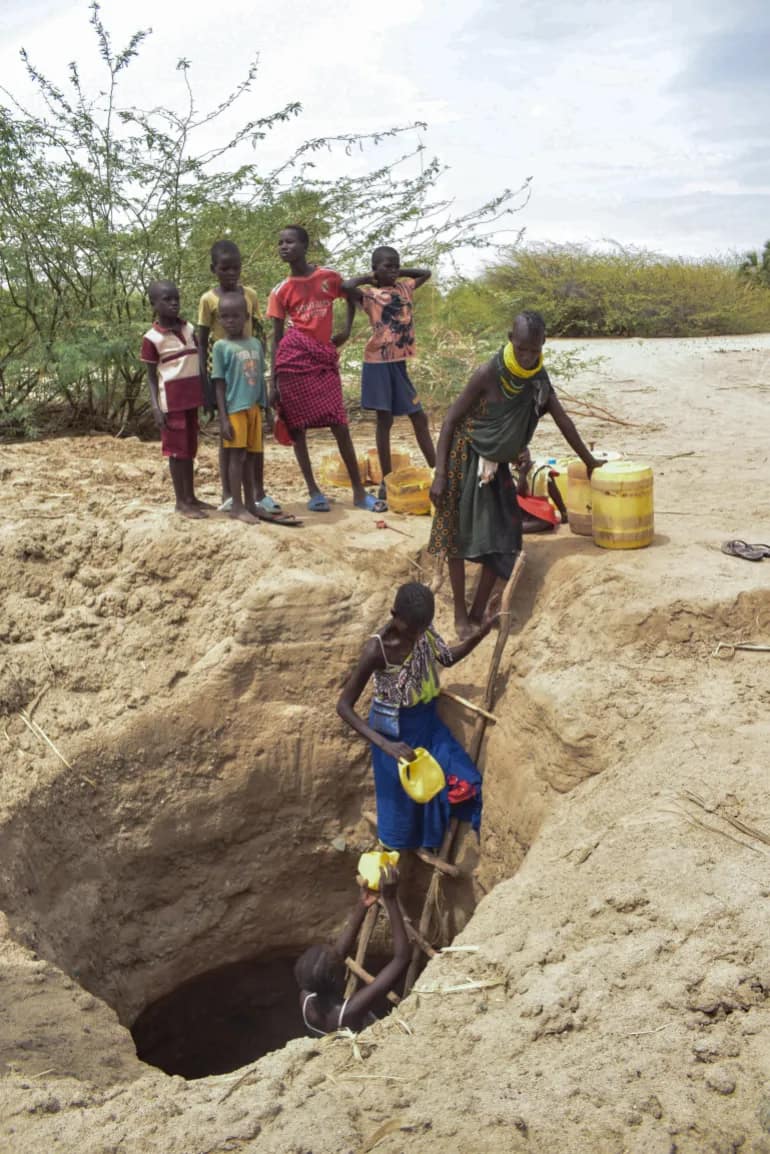
Their destination is a half-dried-up well- a shallow, hand-dug hole in the ground fitted with a wooden ladder-the only reliable water source in the area.
Hundreds of people from surrounding villages gather there daily, alongside their livestock, often waiting for hours to collect small amounts of murky water in plastic containers.
“Once we get here, we dig for water in the well and collect fruits. We wait for the water to fill the well,” says Akalapatan. “We take turns to fetch it because there is so little. There are many of us, and sometimes we fight over it.”
Turkana’s terrain is vast and unforgiving. Roads fade into dust, and settlements are scattered across long distances in a county of just over one million people.
Despite the ongoing rainy season, meteorologists warn that Turkana and other arid and semi-arid regions are likely to receive below-average rainfall, raising fears of a worsening drought.
Authorities say drought conditions are currently affecting 23 of Kenya’s 47 counties. An estimated 3.4 million people are facing food insecurity, while at least 800,000 children are malnourished. Livestock-central to the pastoralist way of life-continue to perish in large numbers.
In Turkana alone, about 350,000 households are at risk of starvation.
“We are suffering from hunger,” Turkana elder Peter Longiron Aemun tells reporters.
“We don’t have water. Our livestock have died. We have nothing. We used to burn charcoal, but there are no acacia trees any more.”
Kenya is still recovering from one of its worst droughts in four decades, which lasted between 2020 and 2023. Experts warn that the current conditions could deepen the crisis.
Scarcity Amid Abundance
Even as communities struggle with acute water shortages-with boreholes broken down and wells and streams running dry- a striking contradiction persists.
Water levels in Lake Turkana have risen in recent years, displacing some communities living along its shores. In other areas, sudden heavy rains have triggered flash floods in typically dry riverbeds, known locally as luggas. However, the water flows too quickly to support sustained agriculture.
At the same time, food scarcity exists alongside surplus.
A report by the World Resources Institute indicates that up to 40% of food produced in Kenya is lost or wasted annually, even as a quarter of the population faces severe food insecurity.
Food losses occur at various stages, including harvesting, storage and transportation, while waste is recorded at the household, retail and restaurant levels.
In parts of the North Rift, farmers have reported strong harvest. However, high food prices and widespread poverty mean that communities in Turkana cannot easily afford supplies transported from these surplus regions.
Security challenges further complicate the situation. Competition over water and pasture continues to fuel tensions, while cattle rustling and banditry remain prevalent in remote areas.
“The biggest problem in drought areas is security,” says Joseph Kamande, a food trader in Wangige.
Still, he believes the country has the potential to achieve food security with better planning.
“The land is vast. Some of it is arable,” he says, adding that “water is the solution.”
Untapped Water Resources
Beneath Turkana’s dry surface lies a largely untapped resource.
In 2013, significant underground water reserves-the Napuu and Lotikipi aquifers- were discovered. The Lotikipi aquifer alone spans approximately 5,000 kilometres and is estimated to hold about 250 trillion litres of water, potentially enough to supply the country for decades.
However, efforts to harness this resource have been hindered by technical and financial challenges.
“The big challenge is salinity,” says Turkana County Water Director Paul Lotum.
“The national government and partners are mapping out pockets where water is safe and reliable. We are working bit by bit to harness it for communities.
Until these challenges are addressed, many residents remain dependent on relief assistance.
Government agencies and humanitarian organisations continue to distribute food and water, but resources are increasingly stretched.
“Most government organisations are either closed or running learner programmes,” says Jacob Ekaran, Turkana’s coordinator for the National Drought Management Authority.
“The resource basket has shrunk. But the government is trying to do more with what it has.”
Surviving on Wild Food
As supplies dwindle, many families are turning to wild fruits and berries.
In Lopur village, Akal Lonyeit Eteng’an prepares a simple meal by boiling foraged berries over an open fire.
She says she has not had a proper meal in two weeks.
“If it doesn’t rain, trees and leaves dry up. There is no water,” she laments, adding that access to healthcare is also limited, with clinics located far from many communities.
Elsewhere, Christine Kiepa faces similar uncertainty.
“I try to look for food. Sometimes it’s not there,” she says. “If I can’t find food, how do I survive?”
Migration and Strain on Communities
The drought is also driving migration.
Male herders, traditionally responsible for livestock, have moved to neighbouring counties in search of pasture and water. Those left behind are largely women, children and the elderly.
This shift is placing additional strain on already vulnerable households.
At the same time, insecurity linked to resource scarcity continues to pose risks to both residents and aid operations.
A Cycle Difficult to Break
For generations, pastoralist communities in northern Kenyan have relied on livestock for survival. However, climate change is increasingly challenging this way of life.
Calls for alternative approaches- including irrigation, drought-resistant crops, tree planting and large-scale water infrastructure- have grown louder in recent years.
“We can change our community mindset,” says Rukia Abubakar, Turkana coordinator for the Red Cross.
“We can plant drought-resistant trees. We can do irrigation. Our soil is good for crop farming.”
Such proposals have been made repeatedly following past droughts, yet implementation has often been slow.
Enduring the Crisis
Back in Kainama, Akalapatan makes the long walk home, carrying 20 litres of water for her family.
It is barely enough.
As her son drinks eagerly from a cup, she knows the supply will soon run out- and that she will have to return to the well again.
For many in Turkana, survival remains a daily struggle shaped by distance, scarcity and uncertainty.